

Quick Answer: A law firm website optimised for lead generation combines fast load speeds, clear calls to action, trust signals, and targeted content. Together, these elements turn casual visitors into genuine enquiries. Getting each layer right means fewer missed opportunities and more prospective clients picking up the phone or filling out your contact form.
Why Your Law Firm’s Website Is Your Most Important Business Asset
Your website isn’t a digital brochure. It’s a 24/7 intake coordinator that either earns new clients or quietly loses them to a competitor down the road.
Most law firm websites fail at the basics. Pages load slowly. Contact forms are buried. Practice area descriptions read like they were written for a law journal rather than a person who just lost their job or is going through a separation.
Here’s the thing: people searching for legal help are already stressed. They’re not browsing casually. They want answers fast, they want to feel confident they’re in capable hands, and they want to know how to take the next step. Your website has seconds to deliver all three of those things before they hit the back button.
Optimising your law firm’s website for lead generation means removing friction at every touchpoint. That’s the lens for everything covered in this guide.
The Technical Foundations That Keep Potential Clients on Your Site
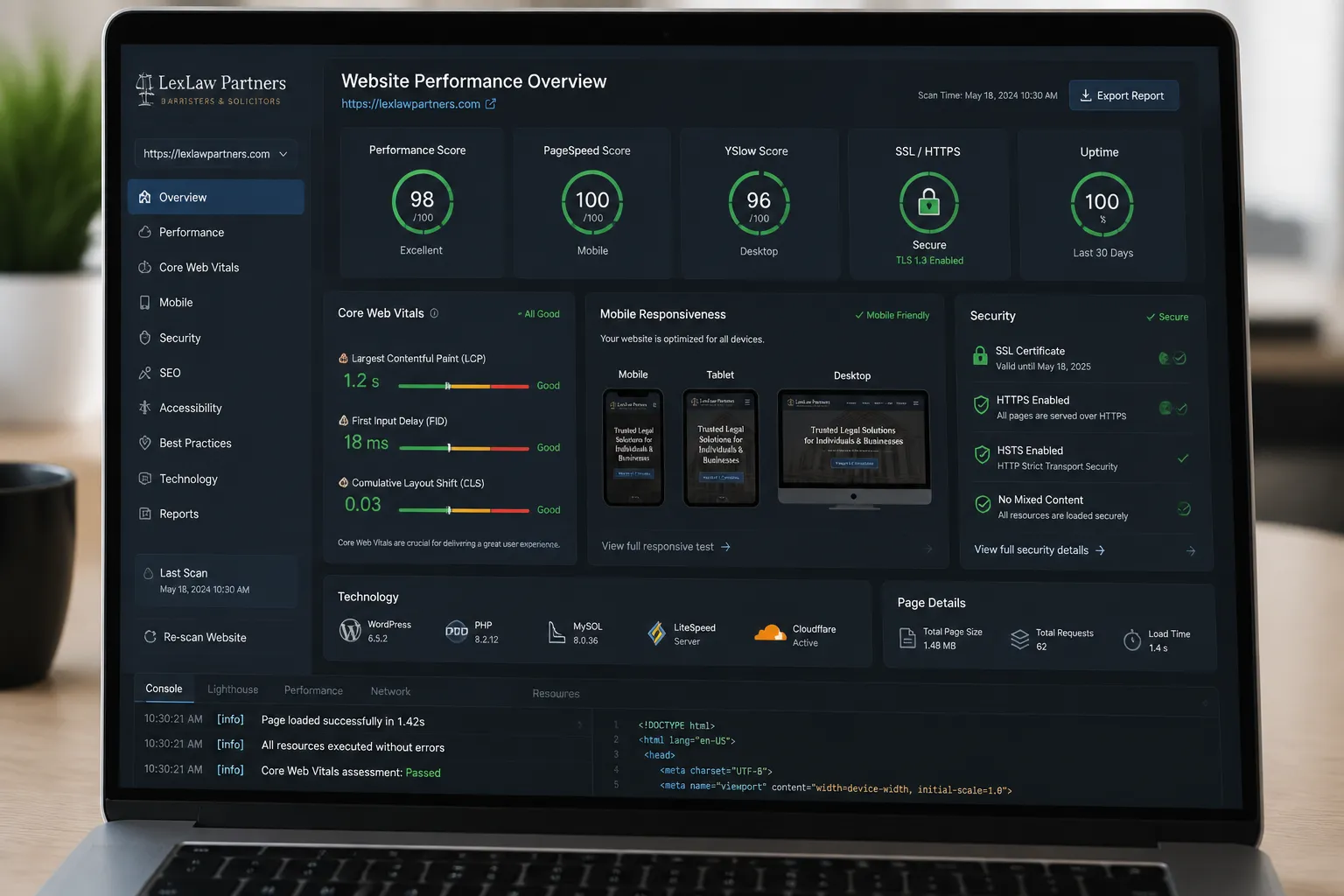
Before you touch a single piece of content, the technical side of your website needs to be solid. A slow, broken, or mobile-unfriendly site will kill conversions regardless of how polished the copy looks.
Key technical factors to address:
- Page speed: Visitors expect a page to load in under three seconds. Beyond that, drop-off rates climb sharply.
- Mobile responsiveness: A significant share of legal searches happen on smartphones. If your site doesn’t display correctly on a small screen, those visitors are gone.
- SSL certificate: A secure connection (HTTPS) is a baseline trust signal. Browsers now flag non-secure sites as warnings, which is a conversion killer for any professional service.
- Core Web Vitals: Google’s performance benchmarks around load speed, interactivity, and visual stability affect both rankings and user experience.
- Clear site architecture: Practice areas, contact details, and your about page should all be reachable within two clicks from the homepage.
If your site is built on a bloated theme or an outdated CMS, these technical issues can be hard to patch without rebuilding from a cleaner foundation.

How to Structure Your Content to Generate Enquiries
Content structure is where most law firm websites leak the most leads. Here’s a straightforward process for getting it right:
- Lead with the client’s problem, not your credentials. The headline on your family law page should speak to what the client is going through, not list your firm’s years of operation.
- Use plain English throughout. Legal jargon creates distance. Write like you’re explaining the process to a friend across a table.
- Have one clear call to action per page. Whether it’s a phone number, a booking form, or a free consultation offer, make it obvious and repeat it naturally across the page.
- Include trust signals near your CTA. Professional memberships, bar association badges, or a brief note about your client communication process all reduce hesitation at the moment someone is deciding whether to reach out.
- Build dedicated landing pages for each practice area. A single “Services” page does not convert as well as a page written specifically for someone searching for a criminal defence lawyer or a property settlement solicitor.
- Add an FAQ section to key pages. Answering common questions on the page keeps visitors engaged and positions your firm as straightforward and approachable.
Local Visibility and Why It Matters for Legal Practices
Most law firms serve a defined geographic area. That means local search visibility is directly tied to the number of enquiries coming through your website.
A few things that influence local visibility:
- Google Business Profile: Keeping this complete and accurate helps your firm appear in map results when someone searches for legal help nearby.
- Location-specific content: If you serve clients across multiple suburbs or regions, having location-relevant pages or content helps your site appear for those specific searches.
- Online reviews: Prospective clients read reviews before making contact. Encouraging satisfied clients to leave honest reviews builds social proof that complements your website.
- Consistent NAP data: Your firm’s name, address, and phone number should be identical across your website, Google Business Profile, and any directories where you’re listed.
These factors work together. A technically sound website with strong local signals and genuine reviews outperforms a visually impressive site that nobody finds.
Understanding What Your Website Visitors Actually Want
Data removes guesswork. If you’re making decisions about your website based on gut feel, you’re likely optimising for the wrong things.
Tools like Google Analytics and Google Search Console are free and show you which pages attract the most visitors, how long people stay, and where they exit without making contact. That information tells you where your conversion funnel is leaking.
Some patterns common to law firm websites:
- High traffic on a practice area page but very few form submissions often point to a missing or unclear CTA.
- A high bounce rate on the homepage suggests the opening message isn’t connecting with what visitors came looking for.
- Most traffic arriving on mobile but a form that’s difficult to complete on a phone is a straightforward fix that often lifts enquiries noticeably.
Running this kind of audit every quarter keeps your site improving rather than stagnating.
Conversion Rate Optimisation: Small Changes, Real Results
You don’t always need a complete redesign to improve lead generation. Targeted changes to the right elements can make a measurable difference.
| Element | Common Problem | Practical Fix |
|—|—|—|
| Contact form | Too many fields, hard to find | Reduce to name, phone, brief message; place above the fold |
| Homepage headline | Firm-centric, vague | Rewrite around the client’s situation or need |
| CTA button copy | “Submit” or “Click Here” | Use action language: “Book a Free Consultation” |
| Page load speed | Heavy images, unoptimised code | Compress images, review hosting, audit plugins |
| Mobile menu | Cluttered, hard to navigate | Simplify structure, make phone number tap-to-call |
| Social proof placement | Buried at the bottom | Move testimonials or trust badges near the primary CTA |
Each of these fixes is relatively low-cost and directly targets the moments where visitors decide whether to contact your firm or move on.
Frequently Asked Questions
Does a slow website actually cost a law firm clients?
A slow website is one of the most direct causes of lost enquiries in professional services. Visitors typically leave a page that takes more than three seconds to load, and law firm prospects searching under pressure are especially unlikely to wait. Speed improvements usually have a direct impact on how many visitors stay long enough to make contact.
Why does the first impression of a law firm’s website matter so much?
First impressions are formed in milliseconds, and a website that looks outdated or loads poorly usually signals to a visitor that the firm may not be detail-oriented. A clean, fast, and professionally structured site typically communicates competence before a single word is read. That initial trust gap is often the difference between an enquiry and a back-button click.
Is building your own law firm website a realistic option?
DIY website builders are accessible, but a law firm website involves more than placing text on a page. It usually requires technical SEO setup, mobile optimisation, conversion-focused structure, and consistent local visibility signals that take meaningful time to learn and implement correctly. For most practitioners, the opportunity cost of managing this themselves is higher than working with someone who handles it directly.
How does link building support a law firm’s website?
Link building involves acquiring references from other credible websites back to your own, which signals authority to search engines. For law firms, links from legal directories, local business associations, and relevant industry publications are particularly valuable. A stronger link profile typically contributes to better organic search positions for practice area and location-based searches.
What should a law firm’s contact page actually include?
A contact page is most effective when it includes a short, low-friction form, a direct phone number that is tap-to-call on mobile, a physical address if the firm sees clients in person, and a brief note about response times. Visitors arriving on a contact page are already interested, so removing any ambiguity or extra steps usually increases the number who follow through.
Getting Your Law Firm’s Website Working Harder
A law firm website that generates consistent leads isn’t the result of one big overhaul. It’s the outcome of getting a set of fundamentals right and maintaining them: technical performance, clear content structure, local visibility, and conversion-focused design.
The firms that do this well aren’t necessarily the ones with the largest budgets. They’re the ones that treat their website as an active business tool rather than a box that got ticked when the firm launched.
If you’d like to see how our web design solutions can help your legal website perform better as a lead generation asset, we’re straightforward to deal with and upfront about what’s involved.